


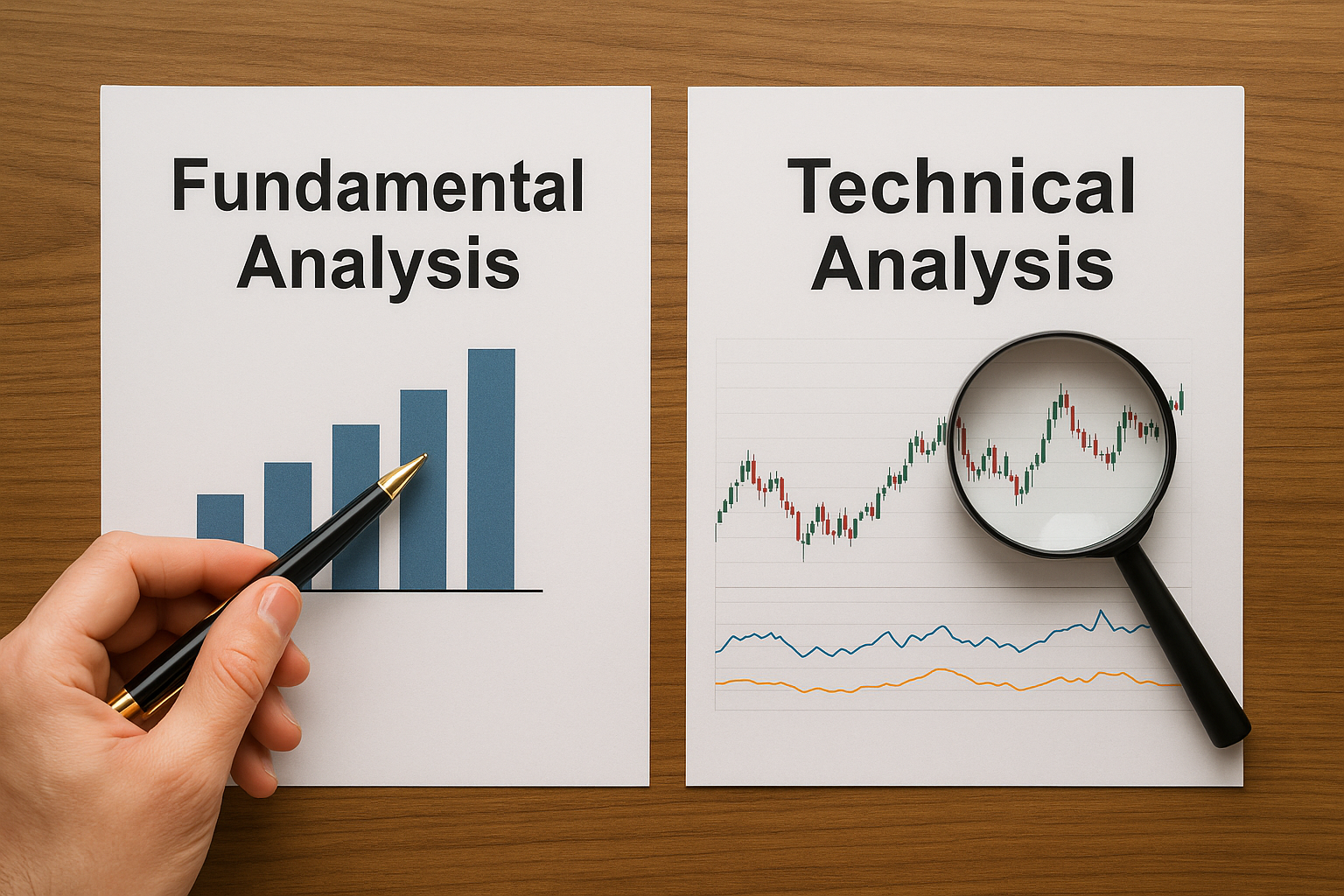
In the world of trading and investing, two main approaches stand above the rest — technical analysis and fundamental analysis. Both have devoted followers and unique strengths, but also limitations. The big question is: which one is better for you as an investor?
What Is Technical Analysis?
Technical analysis focuses on studying price charts, market patterns, and trading volume.
It’s based on the idea that “price discounts everything”, meaning all available information is already reflected in the market price.
Traders use indicators such as moving averages, RSI, MACD, and support/resistance levels to make decisions.
It’s especially useful for identifying trends, entry and exit points, and short- to medium-term opportunities.
Advantages: speed, adaptability to any market, and great for active traders.
Limitations: it doesn’t explain why movements happen and may produce false signals.
What Is Fundamental Analysis?
Fundamental analysis studies the economic, financial, and external factors that influence an asset’s value.
For stocks: earnings, revenue, debt levels, and business outlook.
For currencies: interest rates, inflation, GDP, and central-bank policy.
For commodities: supply, demand, weather, and geopolitical tensions.
Advantages: deep long-term insight and understanding of an asset’s real value.
Limitations: less effective for quick trades and dependent on forecasts or assumptions.
Which Is Better?
It depends on your investment style:
🕒 If you prefer short-term trades or active trading, technical analysis offers faster and clearer signals.
📈 If you invest medium- or long-term, fundamental analysis helps you understand intrinsic value and make strategic decisions.
The Best Approach: Combine Both
The most consistent traders don’t choose between one or the other — they combine both methods:
Use fundamental analysis to define the overall market direction.
Use technical analysis to refine entry and exit timing.
This hybrid strategy allows investors to align market context with technical precision, maximizing opportunities while minimizing risk.
Conclusion
Technical vs. fundamental analysis is not a battle — it’s a partnership. Both are valuable tools for understanding markets. The key is knowing which one fits your investor profile and how to integrate them for smarter, data-driven decisions.
👉 At Inversión Sin Trampa, we teach you how to use both analyses effectively — without falling for empty promises.