

The 50th G7 Summit, held in Italy from June 13 to 15, 2024, was expected to focus on cooperation and stability — instead, it highlighted a growing political divide in global trade.
Leaders from the U.S., EU, Japan, and Canada openly discussed tightening controls on critical technologies, re-routing supply chains away from China, and even expanding trade partnerships within their own blocs.
What was once a discussion about growth became a debate about economic protectionism versus globalization 2.0.
For global investors and forex traders, this was a signal: the rules of trade might be changing again.
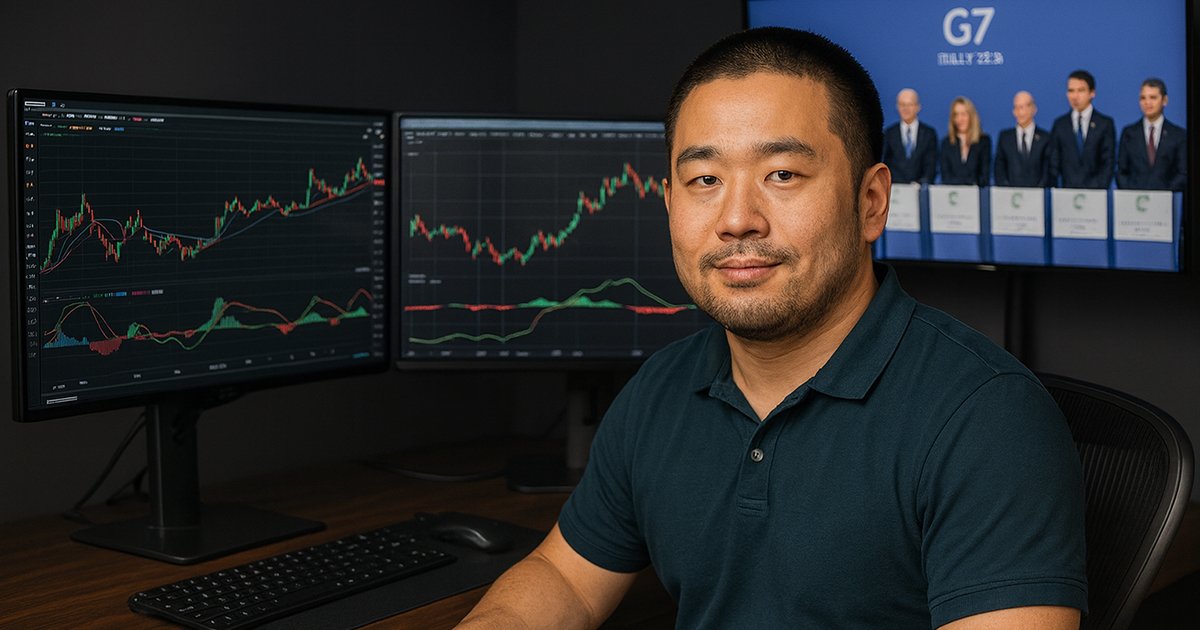
Calvin Yuen:
“The market doesn’t wait for policies to change — it reacts the moment the tone shifts.
When the G7 started talking about ‘strategic decoupling’, I immediately looked for volatility in export-sensitive currencies.”
How Politics Moved the Forex Market
The market response was swift and uneven:
EUR/USD
-
The euro weakened slightly as EU officials hinted at long-term trade friction with Asia.
-
Investors priced in slower export growth for the Eurozone’s manufacturing sector.
-
The pair traded in a downward channel between 1.085 → 1.072, favoring the dollar’s safe-haven appeal.
USD/JPY
-
The yen gained momentum mid-month as risk appetite faded and Japanese assets benefited from safe-haven flows.
-
Short-term traders used the 160.00 zone as a ceiling; the pair briefly fell to 158.30 before rebounding.
AUD/USD
-
The Australian dollar took a hit — down nearly 1.8 % over two weeks.
-
Markets worried about weaker Chinese demand and slower global trade flows.
-
Commodity exports and iron-ore shipments became the key pressure points.
Calvin Yuen:
“The AUD drop wasn’t just technical — it was emotional.
Traders saw ‘trade war 2.0’ headlines and hit the sell button.
I shorted AUD/USD after the G7 press conference and rode the move down with tight trailing stops.”
The Bigger Picture: Trade Realignment Means Volatility
The G7’s renewed emphasis on “economic security” signals a future where global trade is more fragmented.
That has both short- and long-term implications:
-
Short term: sharper swings in commodity and export-driven currencies.
-
Medium term: stronger USD and JPY as defensive plays.
-
Long term: potential growth for regional currencies as new trade routes develop.
Calvin Yuen:
“We’re moving into an era where macro headlines are as tradable as technical patterns.
You can’t just watch charts anymore — you need to read geopolitics like price action.”
Key Takeaways for Traders
-
Geopolitical risk = currency volatility.
Markets will overreact to trade-related statements long before real policies are implemented. -
Safe havens remain essential.
USD, JPY, and CHF tend to strengthen when global trade tensions rise. -
Commodity currencies stay vulnerable.
AUD, CAD, and NZD depend heavily on external demand and sentiment toward China. -
Adaptability beats prediction.
Calvin’s trades were not based on guessing — they were based on reacting to confirmed sentiment shifts.
Conclusion
The June 2024 G7 Summit might be remembered less for its speeches and more for the market turbulence it sparked.
By questioning the balance between globalization and protectionism, world leaders unintentionally triggered a new wave of currency realignment.
For traders like Calvin Yuen, this wasn’t chaos — it was opportunity.
His disciplined strategy turned geopolitical headlines into profit, confirming a timeless rule:
Markets don’t reward predictions; they reward preparation.