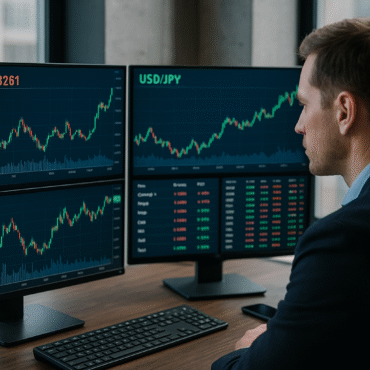



The U.S. dollar vs. euro (USD/EUR) remains one of the most closely watched currency pairs in the world. Not only by professional traders, but by investors, institutions, and analysts who view it as a direct reflection of global economic health.
In 2025, the pair has experienced sharp swings, shifting momentum, and increased sensitivity to global events.
Forex analyst Paul Garrett provides an in-depth look at the key political, monetary, and economic factors influencing USD/EUR, what’s driving current volatility, and what traders can expect looking forward.
1. Diverging Monetary Policies: The Core Driver Behind USD/EUR
One of the strongest forces moving USD/EUR is the contrast between the Federal Reserve (Fed) and the European Central Bank (ECB).
The United States: fighting inflation while protecting growth
The Fed continues to navigate between two pressures:
Cooling inflation that remains above target
Avoiding a recession triggered by high interest rates
When the Federal Reserve signals tightening or fewer rate cuts, the dollar strengthens.
When the Fed turns more dovish, the dollar tends to weaken.
The Eurozone: slower growth and structural challenges
The ECB faces a very different landscape:
Weak consumer spending
Fragile economic recovery
Higher sensitivity to energy prices
Sluggish labor market growth
Paul Garrett notes:
“The euro simply doesn’t have the same monetary room to maneuver as the dollar right now — and markets are pricing that in.”
2. Geopolitics: The Silent Hand Shaping USD/EUR
Geopolitical instability has been a major influence on the FX market this year.
Tensions in Eastern Europe
The prolonged conflict continues to weigh on the euro due to:
Increased energy costs
Lower business confidence
Heightened economic uncertainty
This creates structural weakness for the euro.
Election year in the United States
U.S. elections historically inject volatility into currency markets.
This year is no different.
Uncertainty around:
fiscal policy,
international trade,
and economic direction
can create sudden shifts in USD/EUR.
Garrett emphasizes:
“A strong dollar doesn’t always come from a strong U.S. economy — sometimes it comes from global fear.”
3. Macroeconomic Data: The Numbers That Move the Pair
Three data points have had the biggest impact on USD/EUR this year:
1️⃣ U.S. inflation
If inflation falls → the dollar tends to weaken.
If it rises → markets expect tighter Fed policy → USD strengthens.
2️⃣ Eurozone GDP and employment
The euro struggles when the region shows low productivity, weak hiring, or stagnating growth.
3️⃣ Bond yield spreads
Higher yields on U.S. Treasury bonds attract investors into the dollar, pushing USD/EUR downward for the euro.
4. Market Sentiment: Why Fear Favors the Dollar
One fundamental rule has remained unchanged:
When global risk increases, the dollar gets stronger.
The USD remains the world’s top safe-haven currency.
In periods of:
stock market weakness,
geopolitical instability,
disappointing economic data,
or global uncertainty,
investors move back into the dollar.
Garrett explains:
“The dollar doesn’t need good news to rise — it simply needs the world to feel uncertain.”
5. Outlook for the Coming Months: Paul Garrett’s Scenarios
Paul Garrett outlines three potential paths for USD/EUR:
Scenario 1: A stronger dollar (most likely)
If:
inflation stabilizes in the U.S.,
economic resilience continues,
global risk remains elevated,
then USD/EUR could remain in a bearish trend for the euro.
Scenario 2: Sideways consolidation
If the ECB and Fed align in terms of policy stance, the pair may enter a period of tight ranging.
Scenario 3: Euro recovery
A meaningful rebound is possible if:
the Eurozone shows signs of economic strengthening,
energy pressures ease,
and inflation drops sustainably.
6. What Traders Should Take Away Right Now
To understand USD/EUR is to understand global economics.
Key lessons from Garrett:
✔ Watch the Fed before anything else
Interest rate expectations drive the majority of USD movement.
✔ Monitor Eurozone fundamentals
Weak growth = weak euro.
✔ Don’t underestimate geopolitical risk
It’s the silent mover behind many major currency shifts.
✔ The dollar remains the safest place during global uncertainty
Conclusion: USD/EUR Is the Mirror of the Global Economy
The USD/EUR currency pair is more than a number on a chart.
It’s a real-time indicator of:
transatlantic economic strength,
global political stability,
and the market’s appetite for risk.
As Paul Garrett summarizes:
“If you want to understand where global markets are heading, start with USD/EUR. It reflects the world faster than any other pair.”